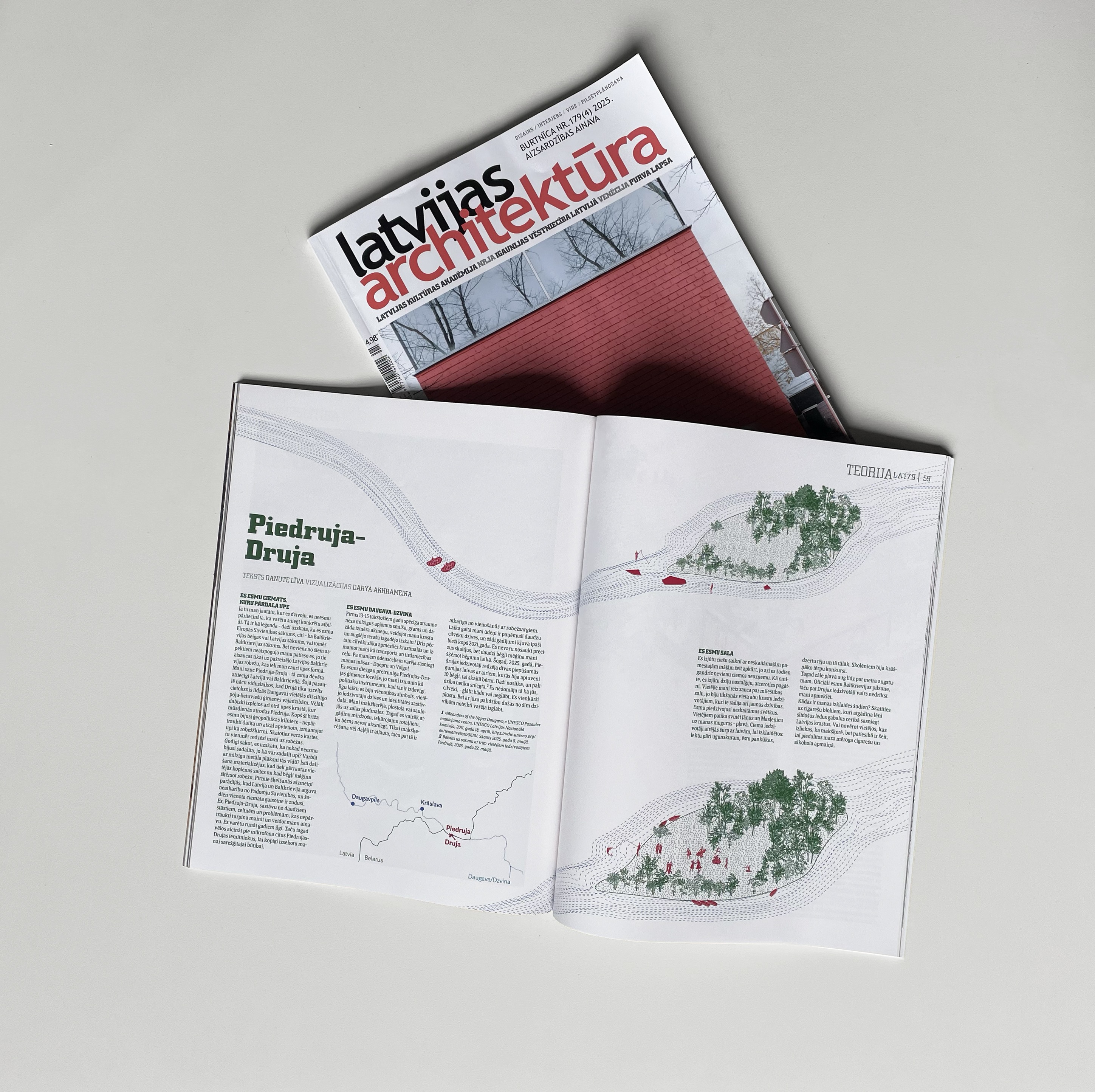
Piedruja-Druja. I am a village split by a river
In collaboration with Darya Akhrameika, done in the framework of the Piedruja-Druja research project.
An essay published in Latvijas Architektūra, a Latvia-based architecture magazine, in an issue curated by Liene Jākobsone from Sampling Architects, focusing on the Landscape of Defence.
The playful essay is written from the perspective of various inhabitants of Piedruja–Druja, such as the island, the border wall, the church and more. Many parts of the information are based on the conversations with the locals.
Fragment of the essay
I am the island
I strongly correlate to the countless abandoned houses around here, as I barely welcome any visitors these days. Like an old granny, a deep sense of nostalgia comes over me when recalling the past. Some locals even used to call me the “love island”, once a meeting point where people from opposite shores came together, and where new lives began.
I’ve witnessed many celebrations. The locals loved to host Midsummer and Maslenitsa celebrations on my back–aka the meadow. Villagers would paddle over on boats to enjoy themselves: jump over fire, eating pancakes, drinking tea, and more. Children from the local school had competitions, especially for the best costumes.
Now, the grass in the meadow grows as tall as one meter. Officially, I am a citizen of Belarus, where even people from Druja are no longer allowed to visit me.
What are the fun activities for me these days? Staring at the large packs of cigarettes, mimicking sheets of ice passing by, hoping to reach the shores of Latvia. Or observing locals, who pretend to fish but are really here for secret meetings, part of a low-level smuggling operation.
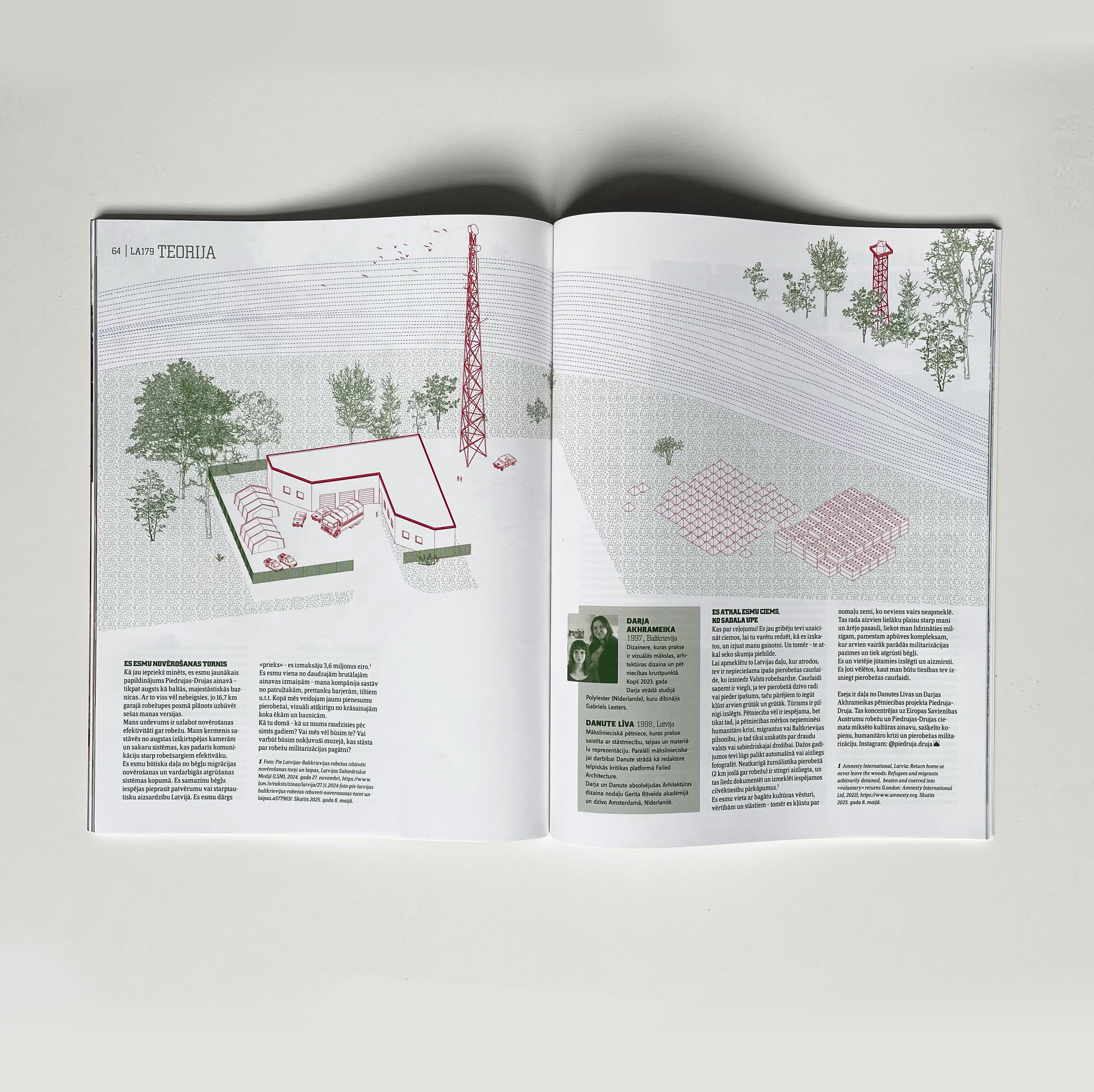
I am the border wall
Technically, a border is a tale produced by humans–an imagined line drawn on a piece of paper. Or does the Daugava-Dzvina flow with conscious intent, following such a line? Well, I’m the physical manifestation of border tales, stretching as long as 145km between Latvia and Belarus.
My creation was driven by the desire to contribute to the so-called Fortress Europe–to make the journey of refugees into the EU even harder, even more violent. I love to compare myself to the Mona Lisa, a painting that has suffered numerous physical attacks, such as humans throwing acid, rocks or even cakes at it. The same–but–different happens to me; I am never complete. Refugees cut holes through me to cross, someone patches me up, and the cycle repeats.
The “final” stage is to build me along places where borders are imagined in the waters, like in Piedruja-Druja. Because of this, land along the Daugava is being deforested. Soon enough, with my help, the people of Piedruja will lose access to the river–a central part of their lives, history, and identity. Does it make them feel “safer”? No. Several local people have said they would feel like animals in a zoo1.
It’s fascinating to observe how government values shift. The land where I am being built is home to many species, including the harkwesp (Garlūpas racējlapsene) and plants like intermediate bedstraw (Šultesa madara), first recorded in Piedruja in 19652.
It grows in forests and bushes, and has been found on private lands around the village, and was maintained with government support due to its risk of extinction–directly linked to deforestation. But when I became a priority, the government immediately forgot about the precious plant. The trees were cut, and the land was expropriated from a local farming family3.
1 Based on a conversation with three local residents in Piedruja, may22, 2025
2 Aizsargājamo ainavu apvidus “Augšdaugava” Dabas aizsardzības plāns, Augšdaugavas un Krāslavas novadi, 2022–2034. Augšdaugavas novada pašvaldība, January 26, 2023, Link. Accessed May 8, 2025.
3 Based on a conversation with a local resident in Piedruja, May 22, 2025